ॐ भूर्भुवः स्वः
तत्सवितुर्वरेण्यं
भर्गो देवस्य धीमहि
धियो यो नः प्रचोदयात् ॥
Om Bhuur-Bhuvah Svah
Tat-Savitur-Varennyam
Bhargo Devasya Dhiimahi
Dhiyo Yo Nah Pracodayaat ||
Meaning:
1: Om, Pervading the Bhu Loka (Earth, Consciousness of the Physical Plane), Bhuvar Loka (Antariksha, The Intermediate Space, Consciousness of Prana) and Swar Loka (Sky, Heaven, Consciousness of the Divine Mind),
2: That Savitur (Savitri, Divine Essence of the Sun) which is the most Adorable,
3: I Meditate on that Divine Effulgence,
4: May that Awaken our Spiritual Intelligence (Spiritual Consciousness).
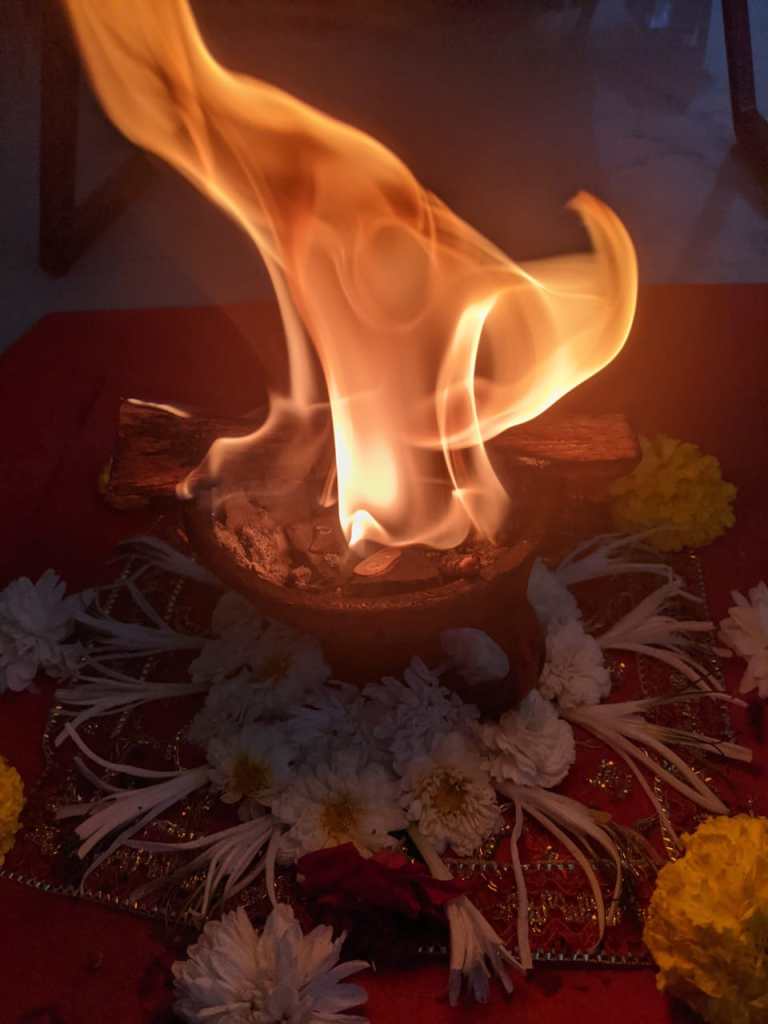
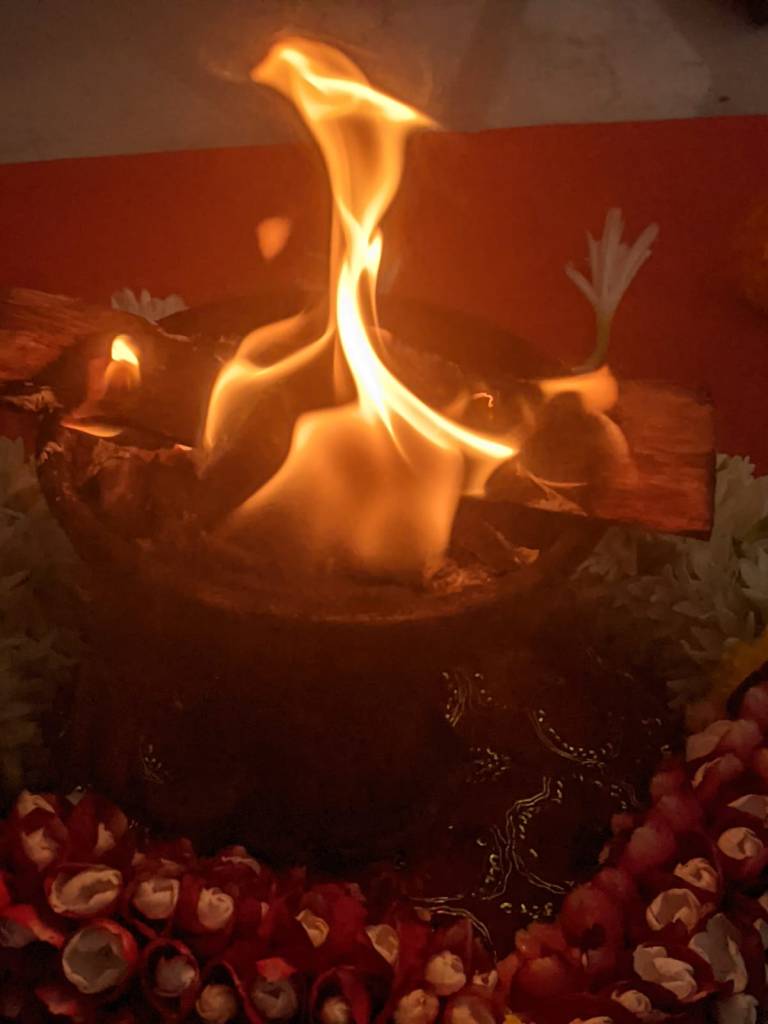
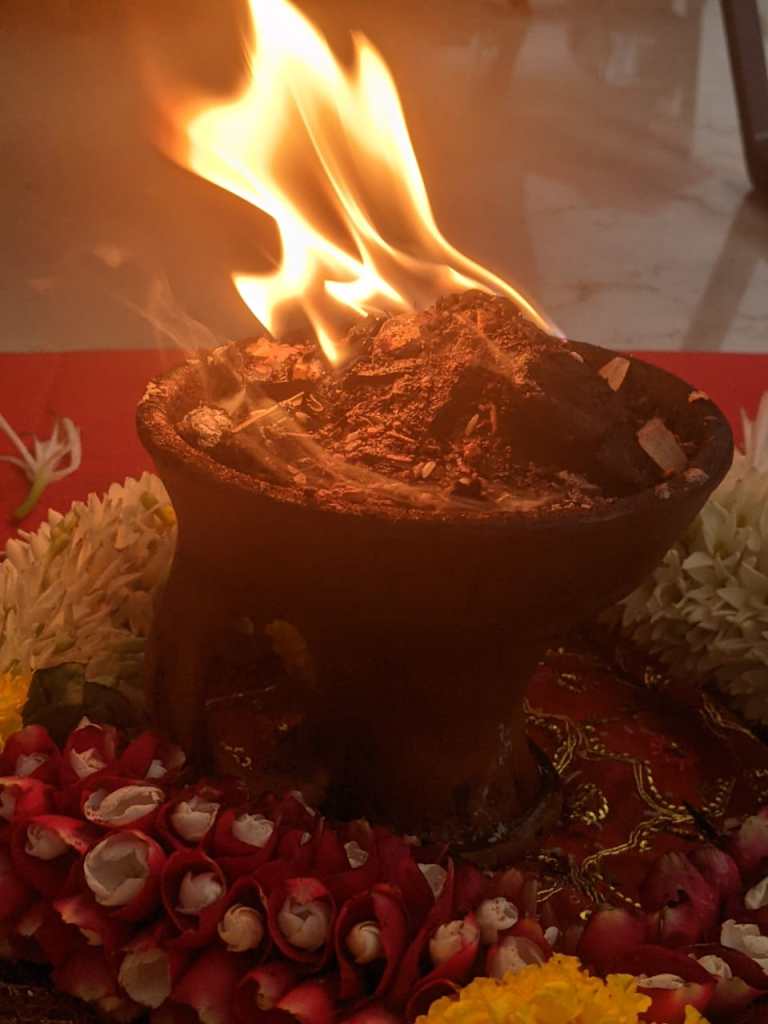
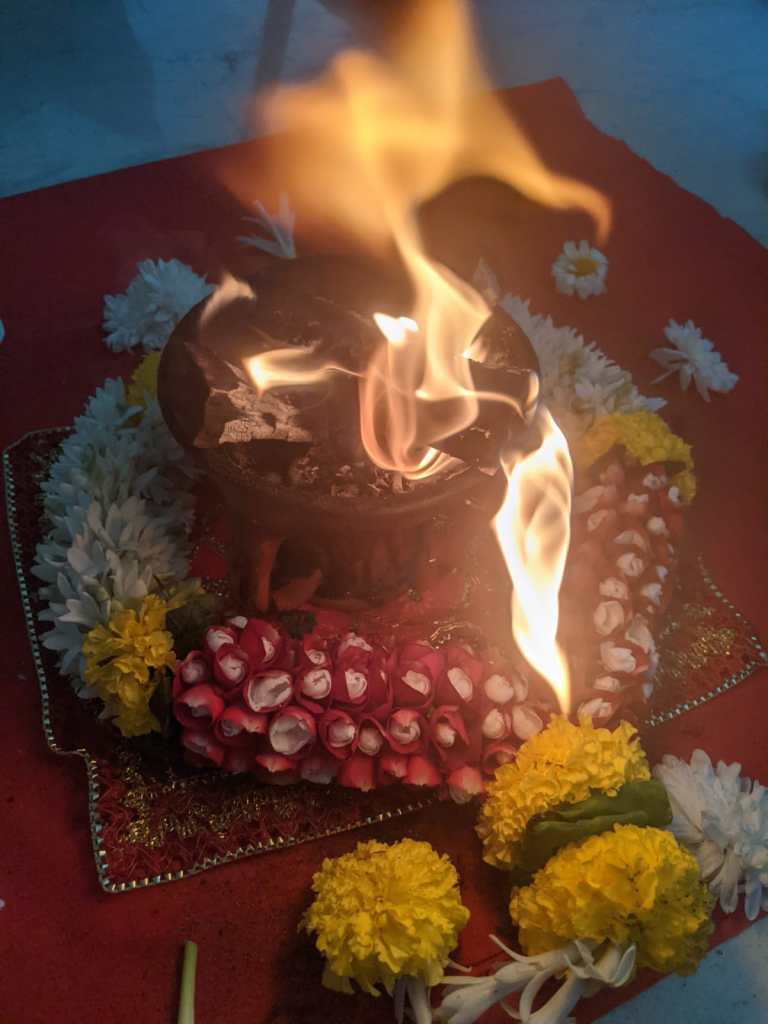
Significance of Homa or Yagña or Havan or Fire Ritual
What is the significance of doing these fire rituals? Connected to divinity. The power of Mantra and consequently, Purification or Clarity. Of mind, body, heart and spirit. Mantra is intimately connected with Homa. And any suitable mantra can be undertaken for the purpose. Chanting any mantra increases the power and focus within oneself.
Homa is performed as part of the year. When the seasons change, the months and the stars. Maybe for a specific purpose. Celebrations, Festivals and Ceremonies.
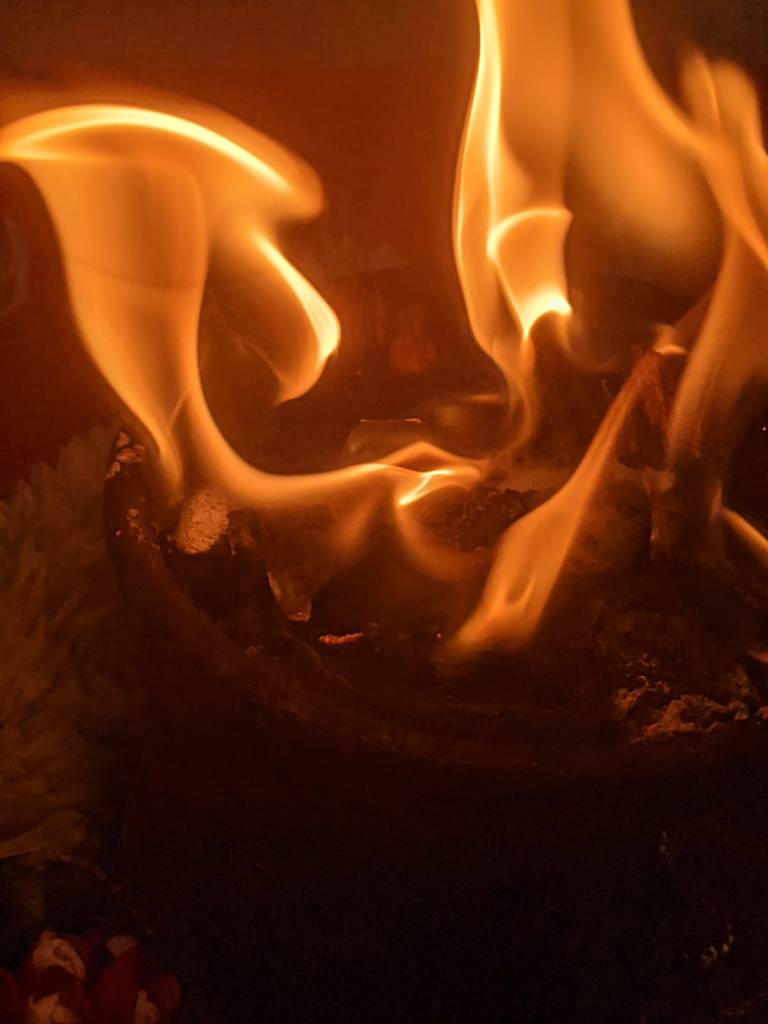
Significance of Homa or almost anything remains subjective. Why you do something. Connection with the fire is a personal journey. It represents Transformation and transmutation. Fire has the capacity to take in all the discordant energies, release and made anew.
When ever we perform any ritual practically, it makes us understand the value of it.
Ritual action is also connected with how one progresses on the spiritual path.
The space is made sacred so we have an opportunity to step into non-ordinary reality. Or the subtle realms which eventually lead to or is encompassed within the subtlest.
To connect with those aspects of ourselves which tend to remain dormant.
Fire is the representation of our own atman, jiva or soul.
It communicates directly with the sun, or the rays of consciousness.
Fire is Prāna, the breath, hence ida, pingala and sushumna nadis. Everything together makes fire. In the form of energy, flowing within and outside our body.
When sacred space is created for any Homa all the elements are present/included/invoked. As well as the directions, planets and solar systems.
It is an attunement with nature and all that is natural.
One may even do Nyasa or Mudra, divination of the body. For purification of the bodily system.
In that time space when Homa is performed there is no duality, you see yourself as one with the Fire.
Whether you make a small or big Homa, it does not make a difference as the purpose is same.
It can become an everyday ritual or perhaps when ever the occasion arises.
Fire is Life!
Ritual Procedure:
Drink lots of water.
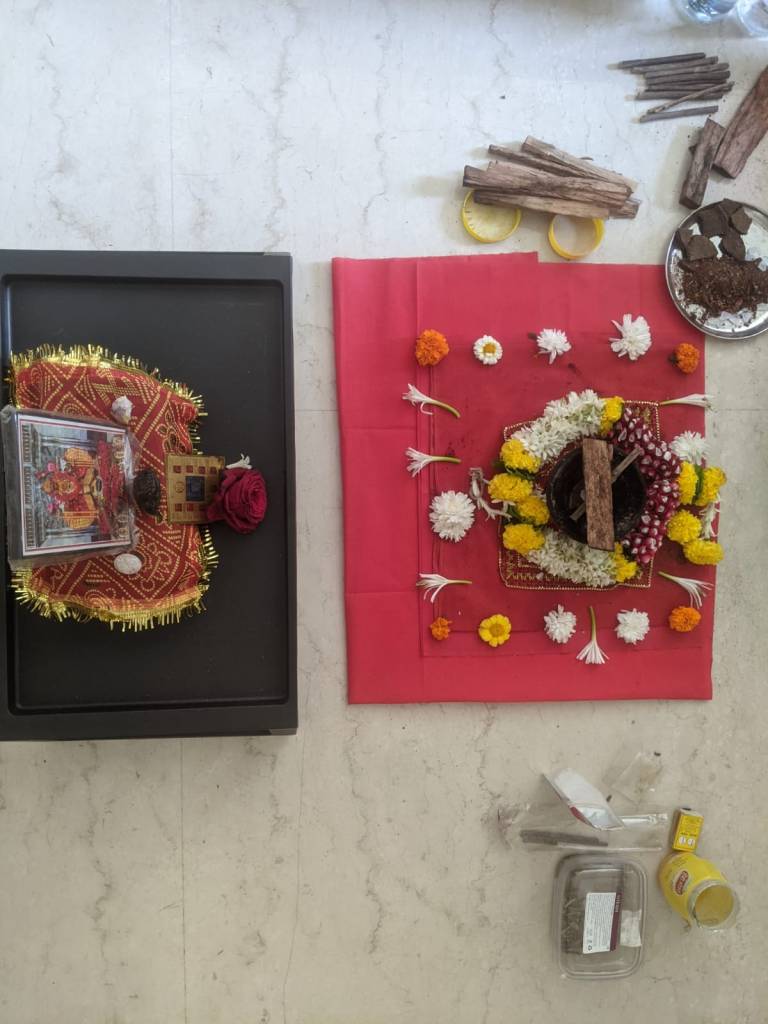
Collect fire wood.
Sometimes Ghee, butter or fragrant oil is used to stoke the fire.
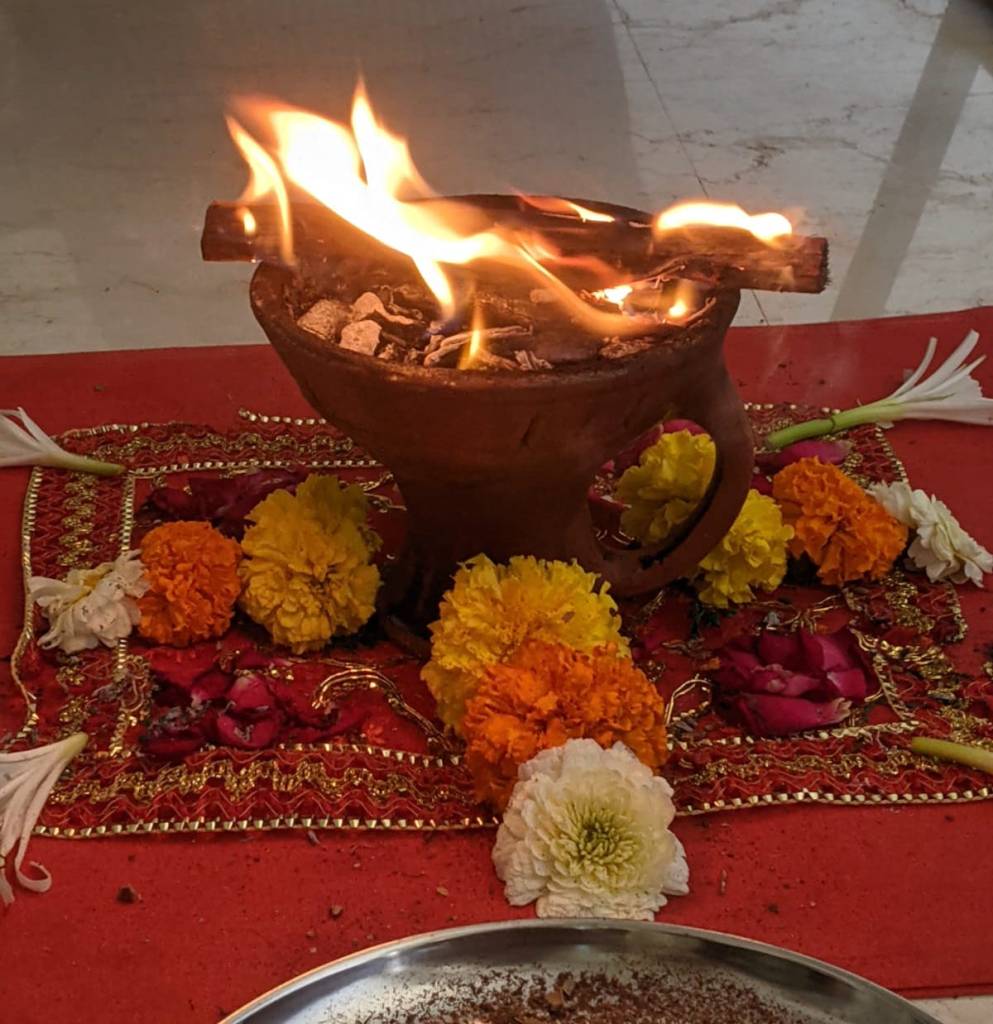
To get the fire going, pieces of dried cow dung and pure Camphor is good.
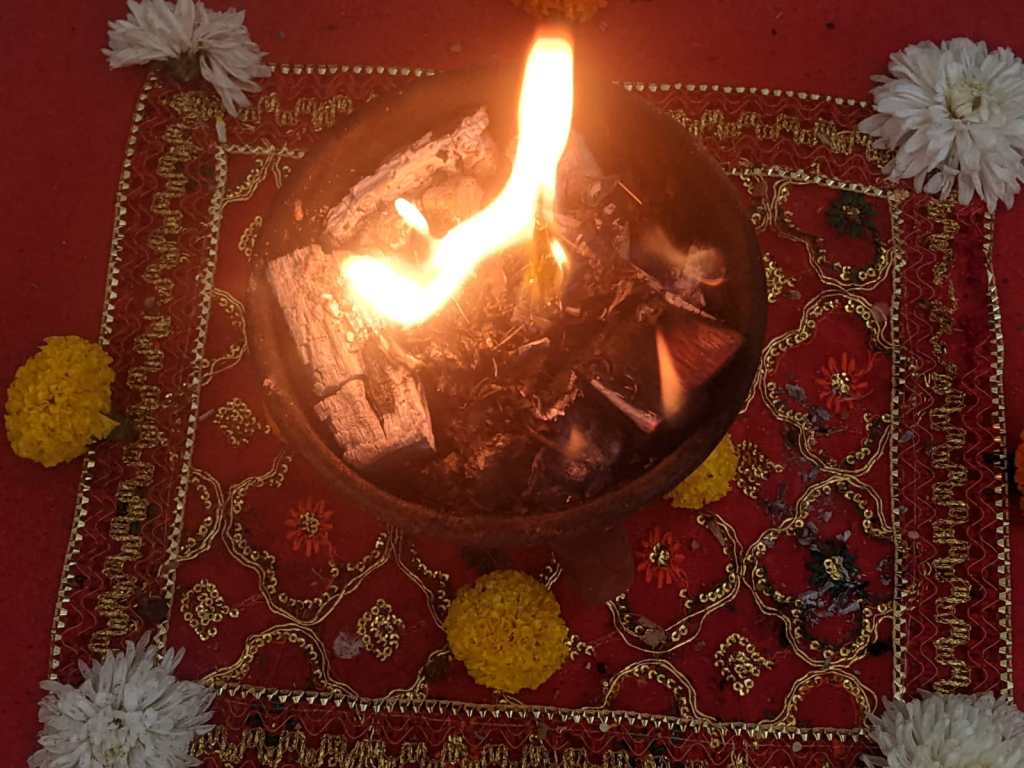
After every or each round of mantra chanting, Havan Samagri or Smudge is traditionally inserted into the fire with a Svaha!
Usage of flowers as decorative items and mandala making is part of the whole process.
Incense sticks, tree resins, may all be put into the fire.
Last but not the least, the image, idol or murti of the diety. Goddess can be placed at the sacred space. This is not a compulsion. Deity worship is a matter of preference and connection.
It is good to do this in a ventilated area / space. Preferably in nature, but if in doors, care should be taken.
Do this alone, with a partner or a group of people.
As an option: to open the space drum, rattle, ring a bell.
Nothing is compulsory.
How to Create Sacred Smudge/Samagri
Alternatives may be used for the following depending on which region of the world you inhabit. You may get just a few of these Leaves/Twigs and whatever else is accessible to you: Eucalyptus, Acacia, Mango, Ashoka, Bamboo, Almond, Basil/Tulsi, Neem, Juniper, Deodar, Coniferous, Pine, White Sage, Tobacco, Sweetgrass, Palo Santo bark, Cedar bark, Thyme, Rosemary, Mugwort/Black Sage, Sandalwood, Peepal, Kush grass, Durva, Bael, Banyan, Shami tree, Cedar chips, Redwood, Banana.
There will be use of different kinds of Crystals namely: Amethyst, Rose quartz, Clear quartz, Carnelian, Agate, Citrine, Sunstone, Obsidian, Tiger’s eye, Jade, Turquoise, Moonstone, Rasper etc
Flower petals: Rose, Marigold, Jasmine, Parijat, Friangipani/Champa, Lavender, Hibiscus, Lotus etc.
Resins: Yerba Santa, Copal, Frankincense, Myrrh, Benzoin, Opoponax, Pine, Camphor.
Procedure to make Havan Samagri or Smudge:
Be connected with your higher self and intuition while preparing to make smudge. As alignment with ones divinity and consciousness plays an important role when working with plant spirit.
Before plucking any plants, leaves or flowers always take permission from it and follow your heart voice. Now dry whatever items collected or are available from the list under the sun for few days till they are completely crispy dried, and only then use it in making smudge/samagri. Please don’t use any damp leaves, flowers, resins or twigs as it will get fungus. Hence drying everything is mandatory for this process.
Start with the Invocation of any god, goddesses, angels etc. as per your belief or faith to be present and help you in this process of making smudge. Now take a big bowl and put all the ingredients in it. Use stones or crystals whichever calls intuitively and place them in the bowl along with other items. Then use sound healing bowls or drums or rattles to bring down the energy of sound into the smudge. Mix all the ingredients, keep a lid cover on the bowl and then keep it outside in Sun and Moon light for 3,5 or 7 consecutive days and nights as per your heart voice/intuition. Letting the divine flow and work with the energies created is extremely important part of making Sacred Smudge/Samagri. After few days of keeping smudge outside, transfer it in any steel or glass container for storing it. Hence, now one can start using it on regular basis or whenever one gets a calling to do smudging in the house. To let the stagnant old energies release by bringing in the new.
MANTRAS
Why does anyone do Mantra? Mantra is not a religious affair. In fact the sounds and syllables are the blueprint of the soul. Therefore, the Sanskrit language views itself as sacred as it stands for the codex of the atman (soul). A further detailed explanation of Mantra will be given elsewhere on this website. Here are a few to get you started and as invocations:
ॐ असतो मा सद्गमय ।
तमसो मा ज्योतिर्गमय ।
मृत्योर्मा अमृतं गमय ।
ॐ शान्तिः शान्तिः शान्तिः ॥
Om Asato Maa Sad-Gamaya |
Tamaso Maa Jyotir-Gamaya |
Mrtyor-Maa Amrtam Gamaya |
Om Shaantih Shaantih Shaantih ||
Meaning:
1: Om, (O Lord) Keep me not in (the Phenomenal World of) Unreality, but make me go towards the Reality (of Eternal Self),
2: Keep me not in (the Ignorant State of) Darkness, but make me go towards the Light (of Spiritual Knowledge),
3: Keep me not in (the World of) Mortality, but make me go towards the World of Immortality (of Self-Realization),
4: Om, Peace, Peace, Peace.
ॐ सर्वेषां स्वस्तिर्भवतु ।
सर्वेषां शान्तिर्भवतु ।
सर्वेषां पूर्णंभवतु ।
सर्वेषां मङ्गलंभवतु ।
ॐ शान्तिः शान्तिः शान्तिः ॥
Om Sarveshaam Svastir-Bhavatu |
Sarveshaam Shaantir-Bhavatu |
Sarveshaam Puurnnam-Bhavatu |
Sarveshaam Manggalam-Bhavatu |
Om Shaantih Shaantih Shaantih ||
Meaning:
1: May there be Well-Being in All,
2: May there be Peace in All,
3: May there be Fulfilment in All,
4: May there be Auspiciousness in All,
5: Om Peace, Peace, Peace.
ॐ सह नाववतु ।
सह नौ भुनक्तु ।
सह वीर्यं करवावहै ।
तेजस्वि नावधीतमस्तु मा विद्विषावहै ।
ॐ शान्तिः शान्तिः शान्तिः ॥
Om Saha Naav[au]-Avatu |
Saha Nau Bhunaktu |
Saha Viiryam Karavaavahai |
Tejasvi Naav[au]-Adhiitam-Astu Maa Vidvissaavahai |
Om Shaantih Shaantih Shaantih ||
Meaning:
1: Om, Together may we two Move (in our Studies, the Teacher and the Student),
2: Together may we two Relish (our Studies, the Teacher and the Student),
3: Together may we perform (our Studies) with Vigour (with deep Concentration),
4: May what has been Studied by us be filled with the Brilliance (of Understanding, leading to Knowledge); May it Not give rise to Hostility (due to lack of Understanding),
5: Om Peace, Peace, Peace.
ॐ पूर्णमदः पूर्णमिदं पूर्णात्पूर्णमुदच्यते ।
पूर्णस्य पूर्णमादाय पूर्णमेवावशिष्यते ॥
ॐ शान्तिः शान्तिः शान्तिः ॥
Om Puurnnam-Adah Puurnnam-Idam Puurnnaat-Puurnnam-Udacyate |
Puurnnasya Puurnnam-Aadaaya Puurnnam-Eva-Avashissyate ||
Om Shaantih Shaantih Shaantih ||
Meaning:
1: Om, That (Outer World) is Purna (Full with Divine Consciousness); This (Inner World) is also Purna (Full with Divine Consciousness); From Purna is manifested Purna (From the Fullness of Divine Consciousness the World is manifested),
2: Taking Purna from Purna, Purna indeed remains (Because Divine Consciousness is Non-Dual and Infinite),
3: Om, Peace, Peace, Peace.
गणानां त्वा गणपतिं हवामहे
कविं कवीनामुपमश्रवस्तमम् ।
ज्येष्ठराजं ब्रह्मणां ब्रह्मणस्पत
आ नः शृण्वन्नूतिभिः सीद सादनम् ॥
Gannaanaam Tvaa Ganna-Patim Havaamahe
Kavim Kaviinaam-Upama-Shravastamam |
Jyessttha-Raajam Brahmannaam Brahmannaspata
Aa Nah Shrnnvan-Uutibhih Siida Saadanam ||
Meaning:
(This Mantra of Rig Veda 2.23.1 is addressed to Brihaspati / Brahmanaspati)
1: Among the Ganas (Group of Prayers), to You Who are the Ganapati (Lord of Prayers), we Offer our Sacrificial Oblations,
2: You are the Wisdom of the Wise and Uppermost in Glory,
3: You are the foremost King of the Prayers, presiding as the Lord of the Prayers (Brahmanaspati),
4: Please come to us by Listening to our Invocation and be Present in the Seat of this Sacred Sacrificial Altar (to charge our Prayers with Your Power and Wisdom).
गुरुर्ब्रह्मा गुरुर्विष्णुर्गुरुर्देवो महेश्वरः ।
गुरुरेव परं ब्रह्म तस्मै श्रीगुरवे नमः ॥
Gurur-Brahmaa Gurur-Vissnnur-Gururdevo Maheshvarah |
Gurure[-I]va Param Brahma Tasmai Shrii-Gurave Namah ||1||
Meaning:
1.1: The Guru is Brahma, the Guru is Vishnu, the Guru Deva is Maheswara (Shiva),
1.2: The Guru is Verily the Para-Brahman (Supreme Brahman); Salutations to that Guru.
Hymn to Agni (the spirit of Fire)
अग्ने नय सुपथा राये अस्मान विश्वानी देव वयुनानि विद्वान्।
युयोध्यस्म ज्जुहुराणमेनो भूयिष्ठां ते नम उक्तिं विधेम ॥
Agne naya supatha raye asman
Visvani deva vayunani vidvan,
yuyo-dhyas-majjuhu-rana-meno
bhuyistham te nama uktim vidhema
त्वमेव माता च पिता त्वमेव ।
त्वमेव बन्धुश्च सखा त्वमेव ।
त्वमेव विद्या द्रविणम् त्वमेव ।
त्वमेव सर्वम् मम देव देव ॥
Tvam-Eva Maataa Ca Pitaa Tvam-Eva |
Tvam-Eva Bandhush-Ca Sakhaa Tvam-Eva |
Tvam-Eva Viidyaa Dravinnam Tvam-Eva |
Tvam-Eva Sarvam Mama Deva Deva ||
Meaning:
1: You Truly are my Mother And You Truly are my Father .
2: You Truly are my Relative And You Truly are my Friend.
3: You Truly are my Knowledge and You Truly are my Wealth.
4: You Truly are my All, My God of Gods.
कर्पूरगौरं करुणावतारं
संसारसारम् भुजगेन्द्रहारम् ।
सदावसन्तं हृदयारविन्दे
भवं भवानीसहितं नमामि ॥
Karpuura-Gauram Karunna-Avataaram
Samsaara-Saaram Bhujage[a-I]ndra-Haaram |
Sadaa-Vasantam Hrdaya-Aravinde
Bhavam Bhavaanii-Sahitam Namaami ||
Meaning:
1: Pure White like Camphor, an Incarnation of Compassion,
2: The Essence of Worldly Existence, Whose Garland is the King of Serpents,
3: Always Dwelling inside the Lotus of the Heart.
4: I Bow to Shiva and Shakti Together.
 Svatantrya Bhairava Shamanism