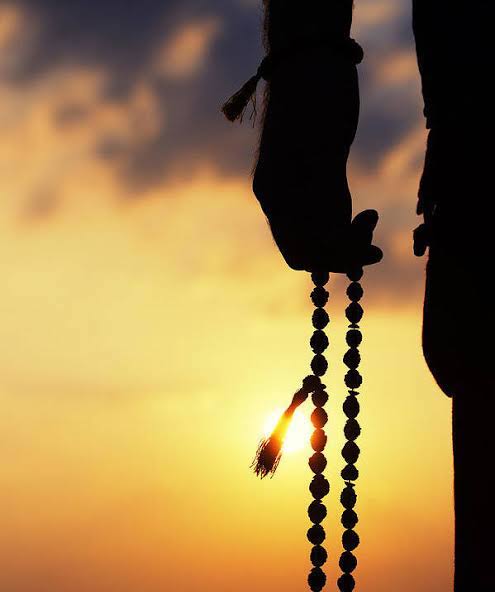
Why do we chant mantra?
Mantra helps us navigate the mystery of life. To gain spiritual confidence and clarity. To empty oneself from all that was/is. To find hope when there is none. To go through years of emptiness and void. We start reciting mantra as a practice. The specifications of which depend on the tradition they belong to and what is needed for the aspirant to work with/on. But the premises are the same: repeat 108 times (one mala) or at least a long duration of time like 1 hour. For its efficacy to take place. It the end this is all we are looking for, some clarity and peace. Nevertheless the two remain elusive as the tendency is to pursue that which does not beget peace. Does it bring enlightenment, not quite. Mantra is used to go beyond the mind. To a space of no-mind. Rest there, Be there.
Mantra also depends on your environment and situation in life. As one might be drawn to do a certain practice at one point into time, and another at another point. Mantras affect us in the way we relate to the world. What we choose and the outcome of those actions. Mantra is powerful when given by a guru which you have some relationship with. Or if it belongs to a deity that you admire.
Mantra is said to save. Save from what? From the natural calamity of oneself. Life can be quite confusing, at best of times. How to navigate these waters successfully? Many, many tools are required. But there’s another part. If one is experiencing reality or great spirit, then what does one do, how to fill the time? Tantras enumerate copious amounts of mantric work. So, even a little bit should help. All this is to make one a bit more subtle towards existence and not so gross. To help us look at the world in different ways and posses different views. So, not only does time get filled, but we get cleared out of all our pre-conceived notions, memories and facts. To make space or make room (or build shakti) for the atman. The just “being” business of life. So that we may approach our own lives a bit wiser or if not that, then at least a bit more free. Freedom from fear, anxiety, inhibitions and depression to say the least.
Mantras have a certain quality to them. And so does chanting. One begins to experience states of consciousness and experiences that were at first just a remote/distant dream. So, to step out of the great “dreaming” and to engage with what truly is, what truly matters and perhaps that which has some sort of value. Bijas (seed syllables) gain their power from the utterance of the sanskrit language. The whole cosmogony of the arising and falling in the Sanskrit language is sacred. From the vowels to the consonants, everything has its sacred meaning and significance. It is the science and building block of the atman. Giving us access to the blueprints of our soul.
To speak directly to the heart of things. Something that is not always easy and it is something that is a rather solitary endeavour. We all are experiencing life subjectively. So the medicine and magic must also be subjective for the place in which we find our selves in, at any given time. The mind is an extremely tricky subject which leaves most people baffled, for centuries. But these are not just cognitive or methods of logic and rationale. This is also about feeling or rasa. As when we chant the musical scales for example. Taking us back to our true state. This is called working on ourselves or sadhana.
Mantra, like deity, works in a very subtle manner. So one needs patience and perhaps a lot of luck as well. Mantra can be done alone, as a couple or in a group.
What we wouldn’t give for a moment of bliss!
Mantra is the communion and attunement with divine and divinity. It is through those sounds and syllables our blue print is created or came into being. As sound is the first breath which we are born with. Mantra chanting brings the rhythm of life in tune or in alignment. As it touches those parts within oneself which longs for true peace, freedom, love and happiness. Mantra is the true union of Shiva-Shakti which are our archetypes in physical form. It opens the heart to receive and understand the importance of expansion within oneself which is rather limited in nature. Continuous chanting of mantra brings focus and solitude by touching that space within which in other ways remains untouched or unheard. The power of any mantra can only be understood when it is chanted for a long period of time could or may be for years. It has the capacity to reverse any false emotions into acceptance of ones natural or real state of being. There is no easy way out or quick fix in it, if one wants to self realize the truth of life.
Mantra when chanted aloud is called Japa and when its chanted in mind it is called Ajapa. So, while we are breathing there is continuous ajapa taking place through inflow and outflow of breath in the form of mantra, without one having any awareness about it. Hence, when we start to chant any mantra it helps to dissipate all the clouds of ignorance by bringing forth true knowledge about ones true self.
Mantras are strings of letters in Sanskrit language that are generally sung to praise and please Gods and Goddesses. It is the fastest way to bridge a gap from gross to subtle levels of body and consciousness. The highest state of ecstasy can be touched or perceived through Bhakti, when one is chanting or hearing mantra with pure devotion and faith.
Mantra chanting is closely and directly associated with Bhakti and Supreme reality. The energy and flow of mantra takes us through different states of higher consciousness by dissolving our identity and duality and becoming one with the divine. During any satsang or kirtans one can realize or touch these states effortlessly. As we become one with the mantra. When listening to loud chants, it helps to shut all the mind or body discomforts and distractions by taking us to the space of silence which is our true state to just Be. Environment created while chanting mantra brings ULLASA – ultimate love, peace, joy and happiness. It brings Shunyata – Void which is rare to find in waking state otherwise.
Mantra Initiation is an age old practice followed through generations, that has been maintained as Guru – Disciple relationship. It is ceremony where guru gives a mantra to his disciple in a sacred space which is sometimes referred as Guru – Mantra Diksha. And this simple thread of exchange of sanskrit letters becomes a living tradition and an unbreakable bond between Guru – Shisya. Mantra given by a guru are generally based or chosen as per the mental and emotional state of a disciple to release or free them from their own pain or suffering.
From the Bhairava Tradition of Swami Lakshmanjoo, Kashmir Shaivism. We have the following vedic time Mula Mantra. Which can be found in the Ramakrishna Mission, Mantrapushpam. As the Pancha Brahma Mantra. To begin your journey into the world of Tantra. It may be practiced as advised for an elongated duration of time and aloud:
Pancha Bhairava, Five Brahmās and the Faces of Sadāśiva
- Sadyojāta
sadyojātaṃ prapadyāmi sadyojātāya vai namo namaḥ
bhave bhave nāti bhave bhavasva mām bhavodbhāvaya namaḥ - Vāmadeva
vāmadevāya namo jyeṣṭhāya namas śreṣṭhāya namo
rudrāya namaḥ kālāya namaḥ kalavikaraṇāya namo balavikaraṇāya namo balāya namo balapramathanāya namas sarvabhūtadamanāya namo manonmanāya namaḥ - Aghora
aghorebhyo ’tha ghorebhyo ghoraghoratarebhyaḥ sarvebhyas śarvasarvebhyo namas te astu rudrarūpebhyaḥ - Tatpuruṣā
tatpuruṣāya vidmahe mahādevāya dhīmahi tanno rudraḥ pracodayāt - Īśāna
īśānas sarvavidyānām īśvaras sarvabhūtānām brahmādhipatir brahmaṇo’dhipatir brahmā śivo me astu sadāśivom
 Svatantrya Bhairava Shamanism